Evaluating Floral on the Pot Watercolor Style 02: A Resource for Creative Projects
When sourcing digital art for personal or professional projects, evaluating the specific features and potential applications of an asset is a critical step. Floral on the Pot Watercolor Style 02 presents itself as a versatile illustration, but its true value depends on how its characteristics align with your particular needs. This discussion examines what defines this resource, how it compares within its category, and the practical decision factors involved in choosing it.
Defining the Distinct Characteristics of This Watercolor Art
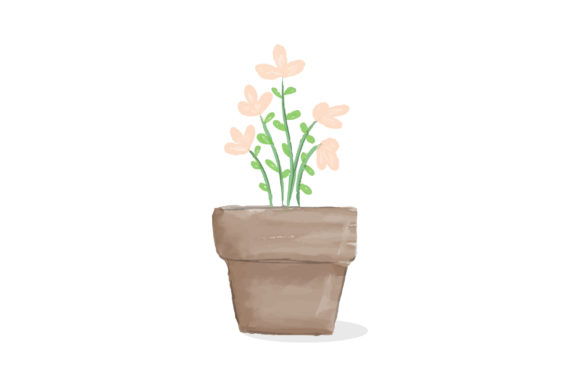
Floral on the Pot Watercolor Style 02 is, at its core, a digital illustration depicting a floral arrangement within a pot or vessel, rendered in a watercolor aesthetic. The “Style 02” designation suggests it is part of a series, potentially offering variations on a theme. The key distinct elements are its artistic medium simulation and its subject matter. The watercolor style implies soft blends, translucent layers, and visible brushstroke textures, creating an organic, hand-painted feel that differs markedly from vector-flat designs or hyper-realistic digital paintings. The composition—a floral pot—anchors it in themes of nature, growth, and domestic beauty, making it inherently suitable for related contexts.
What you receive are two file formats: an .EPS 10 vector file and a high-resolution .JPG at 4000 x 4000 pixels. This dual offering is a significant feature. The EPS format is editable in vector-based software like Adobe Illustrator, allowing for color changes, decomposition of elements, or integration into larger vector compositions without loss of quality. The JPG provides a ready-to-use, raster image of substantial size, suitable for many immediate applications where editing is not required. The inclusion of both addresses two common user scenarios: the need for customization and the need for a high-quality final asset.
Comparing Format and Style with Common Alternatives
To understand where Floral on the Pot Watercolor Style 02 fits, it’s useful to compare it against broader alternatives in digital illustration. Many decorative floral assets come in purely vector formats (SVG, AI) or purely raster formats (PNG, JPG). A purely vector asset offers infinite scalability and easy editing but may lack the textured, artistic nuance of a simulated traditional medium. A purely raster asset, especially one labeled as “watercolor,” might capture that texture beautifully but becomes limited if you need to alter colors or resize beyond its native resolution without degradation.
The hybrid approach of providing both a vector and a raster file, as seen here, is a comparative strength. It bridges the gap between flexibility and aesthetic fidelity. However, a tradeoff exists: the watercolor effect in the vector EPS file may be constructed using complex vector paths and gradients to mimic paint, which can make editing more technically challenging than modifying a simple flat-color vector graphic. Conversely, the high-res JPG captures the texture perfectly but, as a raster file, any scaling beyond 4000px or significant color manipulation will require skilled raster editing software like Photoshop and may result in quality loss.
In terms of style, watercolor illustrations occupy a specific niche compared to other popular styles like digital line art, retro motifs, or photorealistic renders. The watercolor look is associated with warmth, softness, and a certain artistic authenticity. It is less stark than line art and less formal than photorealism. This makes Floral on the Pot Watercolor Style 02 a strong candidate for projects aiming to convey a gentle, artistic, or natural vibe, but potentially a weaker fit for projects requiring bold, minimalist, or ultra-modern aesthetics.
Practical Use Cases and Best-Fit Applications
The listed applications—wallpapers, fabric designs, cards, and more—are realistic, but each has specific requirements that determine if this asset is a good fit.
For wallpaper or background creation, the 4000x4000 JPG is ample for most digital screens and even for moderate print sizes. The watercolor texture can provide a pleasant, non-distracting backdrop. However, if creating a wallpaper for a very large format or needing to adjust the floral arrangement to fit a specific layout, the vector EPS file becomes invaluable.
In fabric design, the vector format is typically preferred for professional textile workflows because it allows for precise color separation (spot colors) and seamless repetition in patterns. The watercolor style, with its soft gradients, might translate into a more complex print process compared to a design with solid color blocks, but it can yield a uniquely artistic fabric. Here, the asset’s suitability depends heavily on your printing method and desired fabric outcome.
For card design (greeting cards, invitations, stationery), this illustration could serve as a central motif. The JPG can be placed directly into a layout, while the EPS allows you to integrate the flowers into a broader vector design, perhaps combining them with custom text or other elements. Its nature-themed elegance makes it a plausible choice for spring announcements, garden party invites, or thank-you cards.
Other plausible uses include website graphics, book covers, packaging accents, or art prints. The strength across these uses is the asset’s dual-format readiness and its specific aesthetic. A limitation is its fixed composition; it is a single illustration of a potted floral arrangement. If your project requires a series of different flower types, isolated individual flowers, or a completely different layout, this single asset would need to be edited or supplemented with other resources.
Decision Factors: When to Choose This Asset and When to Look Elsewhere
Choosing Floral on the Pot Watercolor Style 02 involves weighing several factors against your project parameters and your own technical capabilities.
- Subject and Style Alignment: This is the foremost consideration. If your project’s theme connects to nature, botanicals, home decor, or gentle artistry, the asset is relevant. If your project requires abstract geometry, tech themes, or bold typography, it is likely mismatched.
- Need for Customization: If you anticipate needing to change colors, resize extensively, or extract elements (like using just the pot or just a single flower), the included EPS vector file makes this asset a pragmatic choice. If you plan to use the image as-is with no edits, the JPG alone suffices, and you might compare similar high-res JPGs from other sources.
- Technical Format Requirements: Assess your workflow. Do you primarily use vector software (Illustrator, CorelDRAW) or raster software (Photoshop, Procreate)? The dual format covers both, but if you exclusively work in one environment, ensure the provided file type for that environment meets your quality standards.
- Resolution and Scalability Needs: For large-format printing (e.g., a banner over 4000px wide), the vector EPS is essential for true scalability. For standard web or small print use, the 4000px JPG is more than adequate. Compare this to assets that offer only a 2000px JPG, which would be a limitation for larger prints.
When Floral on the Pot Watercolor Style 02 may be the right choice: You are working on a nature-inspired project; you value the watercolor aesthetic; you require both a ready-to-use image and the flexibility to edit; and the single floral pot composition aligns with your design layout.
When you may need another option: Your project requires a different artistic style (e.g., neon, monoline, 3D); you need a comprehensive set of isolated botanical elements rather than a composed scene; you only need a raster PNG with transparency and the JPG format’s rectangular bounds are restrictive; or you are looking for a more generic background that doesn’t feature a central focal object like a pot.
Evaluating the Tradeoffs of a Defined Artistic Asset
Resources like this occupy a middle ground between fully custom illustrations and generic, royalty-free stock photos. The tradeoff is between uniqueness and specificity. Floral on the Pot Watercolor Style 02 offers a defined, cohesive piece of art. This can speed up a project, providing a polished centerpiece. However, its specificity means it cannot be everything to every project. You cannot easily turn this watercolor pot into a watercolor landscape without significant additional work.
Comparing it to commissioning a custom illustration, this asset is obviously less costly and immediate, but it won’t be tailored to your exact vision. Comparing it to using a vast library of stock photos, this asset offers more artistic coherence and editability via the vector file, but it provides only one image, not a vast selection.
Ultimately, the evaluation hinges on fit. For an individual creating a personal wallpaper, a crafter designing a limited run of greeting cards, or a small business needing a pleasant graphic for a spring campaign, this resource can be a practical, quality solution that balances aesthetic appeal with functional flexibility. For a large-scale commercial project needing a wholly unique brand identity or a designer building an extensive botanical asset library, this single illustration would be just one component among many required.
By understanding what Floral on the Pot Watercolor Style 02 distinctly offers—its watercolor style, its dual formats, and its composed subject—you can more accurately assess its role in your creative process. The decision is less about whether it is universally “good” and more about whether its particular characteristics solve a specific problem or enhance a particular project in your workflow.